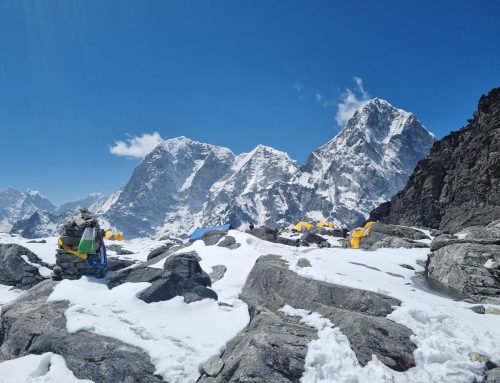
The Manaslu Circuit rarely comes up in the first conversation anyone has about trekking in Nepal. It tends to come up in the second or third one, after someone has done Everest Base Camp or the Annapurna Circuit and wants something that feels less like a managed experience. The circuit around the world’s eighth-highest mountain covers the full range of Nepal’s landscapes, a permit structure that limits daily visitor numbers, and a trail that many trekkers describe as the quietest they have found in the Himalayas.
What Is the Manaslu Circuit?
A circumnavigation of Mount Manaslu (8,163m) in the Gorkha district of northern Nepal. The trek loops around the mountain, beginning and ending near Arughat or Soti Khola in the lower Budi Gandaki valley. At its high point, the route crosses the Larkya La pass at 5,106 metres – one of Nepal’s more demanding high-pass crossings.
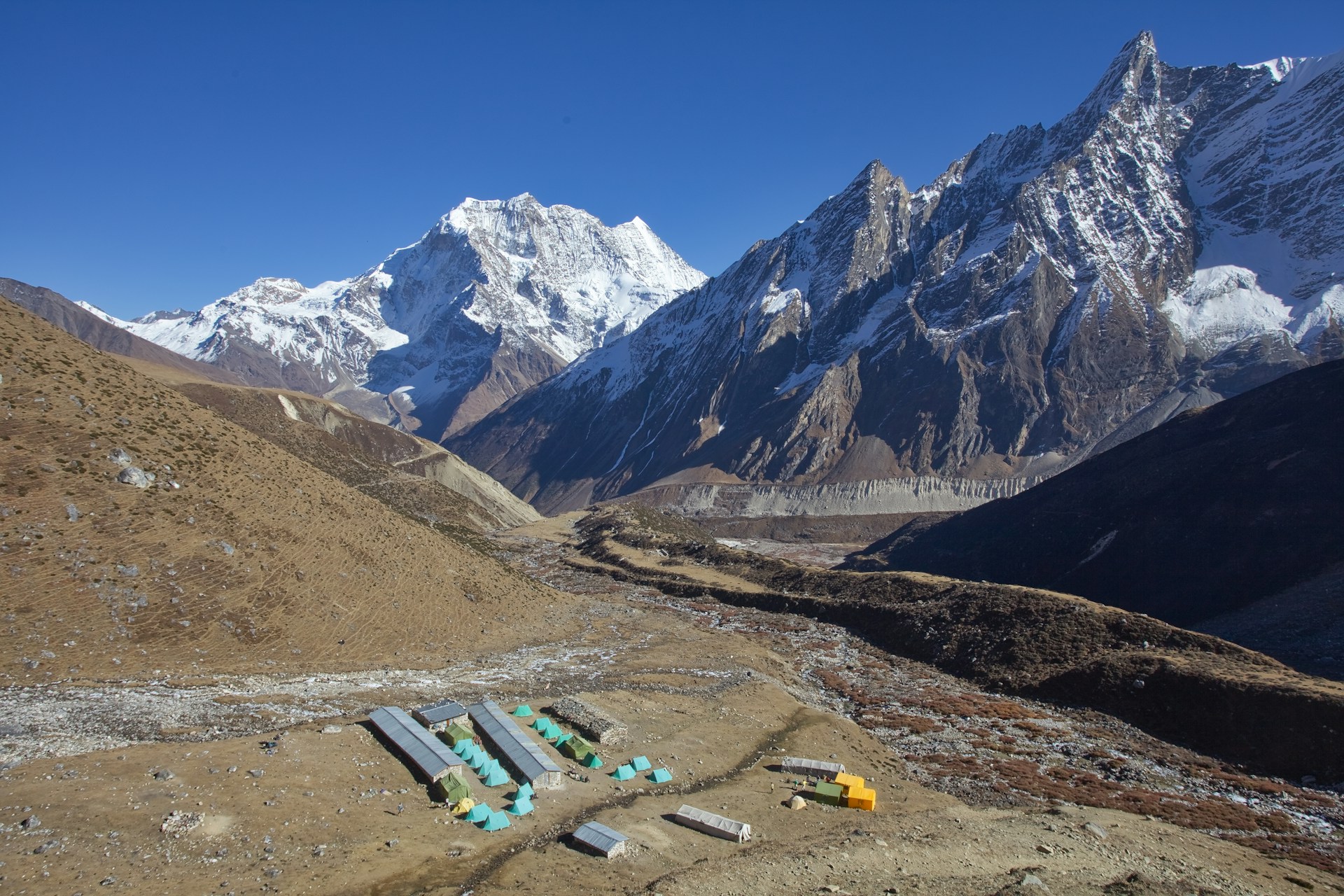
The terrain changes substantially from start to finish. Lower sections are subtropical: rice terraces, rhododendron forests, and Gurung and Nubri villages. As the route climbs, vegetation thins and the cultural character shifts from Hindu to Tibetan Buddhist. Mani walls, prayer flags, and gompas become the dominant features. By the time you reach the high valley below Manaslu’s north face, the terrain is lunar and the silence is complete.
Nepal’s government restricts access to the Manaslu Conservation Area beyond a certain point. Only trekkers with a licensed guide and at least one other person in their group are allowed in. This restriction, combined with the permit cost, keeps numbers substantially lower than on the main Everest and Annapurna routes.
The Route in Stages
Most itineraries run anticlockwise, starting from the lower Budi Gandaki and crossing the Larkya La from east to west. This direction puts the high pass late in the trek, by which point the body has had time to acclimatise through the gradual valley ascent.
Arughat / Soti Khola to Deng (Days 1-3)
Getting to the trailhead means a seven to eight-hour drive from Kathmandu to Arughat or Soti Khola, or a shorter drive to Gorkha followed by a jeep transfer. The opening days follow the Budi Gandaki river through its gorge section – narrow trails, often cut directly into cliffs above the river. Gradient variation is highest here. Small villages, limited infrastructure.
Deng to Samdo (Days 4-7)
The valley opens. Villages grow larger and Tibetan Buddhist influence begins to appear. Namrung, Lho, Samagaon, and Samdo are the main staging posts through this section. Samagaon at 3,530 metres is a common acclimatisation base before the high camp push. On clear days, Manaslu’s north face occupies the entire upper field of view.
Samdo, at 3,875 metres, sits near the Tibetan border. The terrain here is fully high-altitude arid – the character that defines the Manaslu region above 3,500 metres.
Dharamsala / Larkya La Crossing (Days 8-9)
Dharamsala is the high camp for the Larkya La crossing, at around 4,460 metres. The pass crossing covers roughly 18 kilometres, beginning before dawn. The descent leads into the Marsyangdi Valley and the trail connection to the Annapurna region.
In good conditions, the Larkya La is a sustained glacier and snow walk, not a technical climb. In poor conditions it can be dangerous and is sometimes closed. October through November and March through May are the most reliable windows.
Bhimtang to Besisahar (Days 10-12)
The descent from the pass to Bhimtang is steep and, in spring, often through patches of snow. From Bhimtang, the route drops rapidly. The lower Marsyangdi valley is greener and warmer, and by Dharapani or Besisahar you are back in the subtropical lower hills. Most trekkers finish at Besisahar and take a bus or jeep to Kathmandu.
Permits
Four separate permits are required. More paperwork than most Nepal treks, and the restricted area permit is substantially more expensive than standard conservation area entry.
Restricted Area Permit (RAP)
Issued for a fixed number of days, with a daily rate for any extension.
- Peak season (September to November): USD 100 for the first 7 days, USD 15 per additional day
- Off-season (December to August): USD 75 for the first 7 days, USD 10 per additional day
The RAP cannot be obtained independently. Applications go through a registered trekking agency, and you must be part of a group of at least two. Solo trekkers are not permitted in the restricted area.
Manaslu Conservation Area Permit (MCAP)
Covers entry to the Manaslu Conservation Area. Cost: USD 30 per person.
Annapurna Conservation Area Permit (ACAP)
The final section after the Larkya La descends into the Annapurna Conservation Area, which requires this permit. Cost: USD 30 per person.
Chumnubri Rural Municipality Fee
A local fee collected at checkpoints within the municipality. Cost: approximately USD 15 per person.
Total Permit Cost
In peak season (September to November) for a 10-day restricted area permit: approximately USD 255-280 per person. Off-season for the same duration: approximately USD 220-240 per person. These figures exclude the trekking agency service fee.
Cost Overview
Organised treks on the Manaslu Circuit are considerably more affordable than comparable restricted area routes elsewhere in Nepal. Agency packages covering permits, guide, porter, accommodation, and meals typically fall between USD 1,100 and USD 1,500 per person for a standard itinerary.
For those managing some costs independently:
- Daily budget for accommodation and meals on the trail: approximately USD 50-70 per day
- Guide fee (included in most packages, but approximately USD 25-40 per day if hired independently)
- Porter: approximately USD 20-25 per day
- Transport from Kathmandu to trailhead: USD 30-60 depending on vehicle type
Best Time to Trek
Autumn (September to November)
Clear skies, manageable temperatures at altitude, and the most reliable Larkya La crossing. October and November are the busiest months, though the restricted area permit caps mean busy on the Manaslu Circuit still feels quiet compared to Everest or Annapurna.
A trekker who completed the route in October 2025 told us the trail had sunshine every day for the full 10-day itinerary, with tea houses that were warm and well-stocked. Another who walked it in November the same year described consistent conditions throughout 12 days, with only a light dusting of snow near the pass.
Spring (March to May)
Good conditions in March and April; by late May, pre-monsoon instability begins. Rhododendron forests in the lower valley are at peak colour in late March and April. Permit costs are lower than peak autumn rates.
Winter (December to February)
Possible, but demands good cold-weather gear. The Larkya La can have significant snow accumulation, and temperatures at Dharamsala high camp can drop to minus 20 Celsius. Not recommended as a first Himalayan trekking experience.
Monsoon (June to August)
Not suitable. Landslides in the lower Budi Gandaki gorge section are a real risk during heavy monsoon rainfall.
Difficulty
Moderate to challenging. The main factors:
- Duration: most complete itineraries run 12-16 days of continuous walking
- High pass: the Larkya La at 5,106 metres requires a long summit day beginning before dawn
- Remoteness: the middle and upper sections have limited evacuation options; the nearest hospital is days away
- Terrain: the gorge section in the lower valley involves narrow cliff-side trails with significant drops
What the Manaslu Circuit does not involve is the technical mountaineering required for trekking peaks like Mera or Island. The pass crossing is a glacier walk, not a climb. Appropriate for trekkers who have completed a multi-day high-altitude trek before and are physically consistent.
Trekkers who have done both the Annapurna Circuit and the Manaslu Circuit consistently note that Manaslu feels less commercial and more remote at every stage. Far fewer western trekkers. Far more local traffic: herders, traders, and pilgrims moving between villages. One trekker described it as feeling at one with nature rather than stuck in tourist traffic jams. That holds at most points on the route.
Accommodation and Food
Tea houses run the length of the standard route, with quality varying significantly by elevation. The lower Budi Gandaki section has basic facilities. Higher up through Samagaon and Samdo, rooms are more comfortable by Himalayan standards – heated common rooms, better mattresses, more food variety.
Dal bhat, noodle soups, and tea house staples are reliably available throughout. At Samagaon and Samdo, local barley-based dishes and yak products appear alongside the standard trekking fare.
Dharamsala high camp is the most basic stop on the route – simple wooden structures at high altitude. Not comfortable, but functional for a one-night stay.
Logistics
Reaching the Trailhead
The trailhead at Soti Khola or Arughat is reached by road from Kathmandu. The drive takes seven to eight hours depending on road conditions. Jeep transfer is standard. Some itineraries use a Machha Khola starting point, reached by a shorter drive.
Finishing the Trek
The route exits at Besisahar in the Marsyangdi Valley, with bus and jeep connections to Pokhara (roughly three hours) or Kathmandu (five to six hours). Some trekkers extend into the Annapurna Circuit from here – the trails connect naturally.
Guide Requirement
A licensed guide is mandatory for the restricted area section. In remote terrain where the nearest evacuation option is a helicopter, not a road, a good guide is also an essential safety resource. Comprehensive travel insurance covering helicopter evacuation to at least 5,500 metres is required. Check the altitude limit on your policy before departure.
Why This Trek Is Worth the Paperwork
The Manaslu Circuit involves more permits than most Nepal treks, requires more advance planning, and cannot be done independently. Those constraints are also what preserve the experience. The trail does not look like a managed tourist corridor because it is not one. Villages feel inhabited rather than visitor-oriented. The terrain at altitude is genuinely wild.
For trekkers who have done the main routes and want something with more of the character that drew them to Nepal in the first place, the Manaslu Circuit delivers that consistently. The permit system ensures it stays that way.